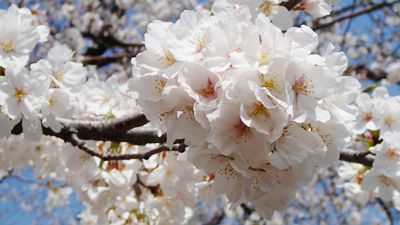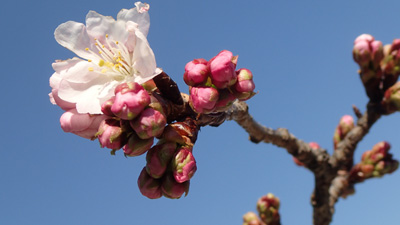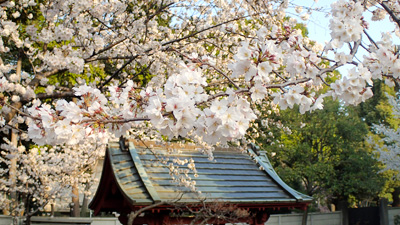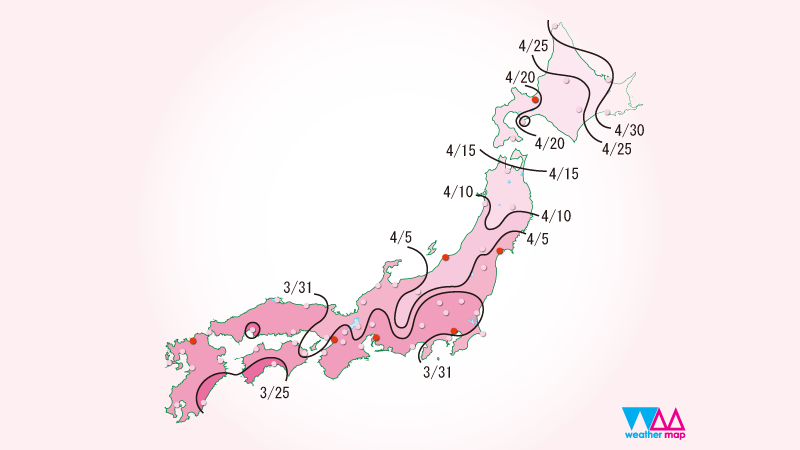



Cherry blossoms are gradually reaching full bloom across many areas, and they are now at their best viewing stage over a wide region. From the Kanto region westward, the peak is expected to continue through this weekend.
This year, many locations have seen earlier-than-average flowering, with some areas in eastern Japan experiencing significantly early blooming. In northern Japan, flowering is progressing earlier than in the previous forecast.
This winter, cold air masses arrived repeatedly, but they did not last long, and there were also periods of notably high temperatures. As a result, dormancy breaking is thought to have been somewhat weaker than average in many areas, with this tendency becoming more pronounced toward the west.
Since mid-February, temperatures have been considerably warm. The return of colder conditions has been temporary, and warmer conditions have continued through the latter half of March. Consequently, flowering occurred earlier than average in western Japan, with some areas in eastern Japan seeing significantly early blooming.
In northern Japan, temperatures are forecast to be considerably higher than average through April, so flowering is expected to be significantly earlier as well.
(Updated Mar 30, 2026)

Note: Detailed forecast is only available in Japanese.
| Kanto/Koshin | ||
| Cities | First bloom | Full bloom |
| Mito | 3/25 | 4/3 |
| Utsunomiya | 3/24 | 4/3 |
| Maebashi | 3/22 | 4/1 |
| Kumagaya | 3/23 | 4/3 |
| Tokyo | 3/19 | 3/28 |
| Choshi | 3/25 | 4/3 |
| Yokohama | 3/22 | 4/1 |
| Nagano | 3/31 | 4/6 |
| Kofu | 3/16 | 3/24 |
| Tokai/Hokuriku | ||
| Cities | First bloom | Full bloom |
| Shizuoka | 3/20 | 4/2 |
| Nagoya | 3/17 | 3/30 |
| Gifu | 3/16 | 3/26 |
| Tsu | 3/24 | 3/29 |
| Niigata | 3/31 | 4/3 |
| Toyama | 3/29 | 4/2 |
| Kanazawa | 3/29 | 4/3 |
| Fukui | 3/29 | 3/31 |
| Kinki | ||
| Cities | First bloom | Full bloom |
| Hikone | 3/29 | 4/2 |
| Kyoto | 3/23 | 3/30 |
| Osaka | 3/26 | 4/3 |
| Kobe | 3/27 | 4/5 |
| Nara | 3/24 | 3/31 |
| Wakayama | 3/24 | 4/2 |
| Chugoku/Shikoku | ||
| Cities | First bloom | Full bloom |
| Okayama | 3/25 | 3/31 |
| Hiroshima | 3/19 | 3/30 |
| Matsue | 3/27 | 3/31 |
| Tottori | 3/28 | 3/31 |
| Takamatsu | 3/25 | 4/1 |
| Tokushima | 3/28 | 4/6 |
| Matsuyama | 3/24 | 4/4 |
| Kochi | 3/16 | 3/31 |
| Shimonoseki | 3/24 | 4/6 |
| Kyushu | ||
| Cities | First bloom | Full bloom |
| Fukuoka | 3/24 | 4/3 |
| Oita | 3/24 | 4/5 |
| Nagasaki | 3/27 | 4/3 |
| Saga | 3/21 | 4/3 |
| Kumamoto | 3/23 | 4/2 |
| Miyazaki | 3/24 | 4/3 |
| Kagoshima | 3/27 | 4/5 |
| Amami/Okinawa | ||
| Cities | First bloom | Full bloom |
| Naze | 2/1 | --- |
| Naha | 1/18 | 2/3 |
| Minamidaitojima | 3/2 | --- |
| Miyakojima | 1/9 | 2/6 |
| Ishigakijima | 2/4 | 2/18 |
|
◇The colored places indicate points which already have passed first or full bloom.
◆Okinawa and Amami regions are areas where forecasts are not provided. |
||
| Tohoku | ||
| Cities | First bloom | Full bloom |
| Aomori | 4/13 | 4/16 |
| Akita | 4/6 | 4/9 |
| Morioka | 4/7 | 4/12 |
| Sendai | 3/31 | 4/4 |
| Yamagata | 4/2 | 4/6 |
| Fukushima | 3/29 | 4/3 |
| ◆Hokkaido (Wakkanai, Asahikawa, Abashiri, Obihiro, Kushiro) has a different species of cherry blossom trees - Ezoyamazakuara. | ||
| Hokkaido | ||
| Cities | First bloom | Full bloom |
| Sapporo | 4/18 | 4/24 |
| Wakkanai | 5/1 | 5/6 |
| Asahikawa | 4/21 | 4/26 |
| Abashiri | 5/3 | 5/7 |
| Kushiro | 5/3 | 5/6 |
| Obihiro | 4/18 | 4/22 |
| Muroran | 4/23 | 4/28 |
| Hakodate | 4/18 | 4/20 |

Cherry Blossom Forecast 2026 Schedule
- First Forecast Issued January 22nd
- Second Forecast Issued February 5th
- Third Forecast Issued February 12th
- Fourth Forecast Issued February 19th
- Fifth Forecast Issued February 26th
After March 2nd, we will update the first bloom and full bloom reports every day and provide forecasts every Monday and Thursday.
Forecast Criteria
The forecast is based on the bloom timeline of the official observation trees that are located at the 58 Japan Meteorological Agency offices across the country.
We release the forecast for 53 points in Japan except for Amami and Okinawa regions where there are no official observation trees available.
We release the forecast for 53 points in Japan except for Amami and Okinawa regions where there are no official observation trees available.
Blossom Criteria
The forecast is based on the bloom timeline of the official observation tree.
"First bloom" means observation trees have 5 to 6 flowers that have bloomed.
"Full bloom" means 80% of the observation tree flowers have bloomed.
We forecast the "Date of First Bloom" and "Date of Full Bloom" according to these meanings, which are the same with JMA's observation rules.
On average, tree fully blooms a week after first bloom.
"First bloom" means observation trees have 5 to 6 flowers that have bloomed.
"Full bloom" means 80% of the observation tree flowers have bloomed.
We forecast the "Date of First Bloom" and "Date of Full Bloom" according to these meanings, which are the same with JMA's observation rules.
On average, tree fully blooms a week after first bloom.